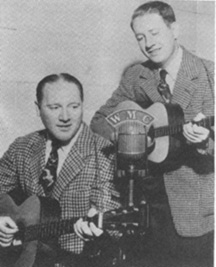
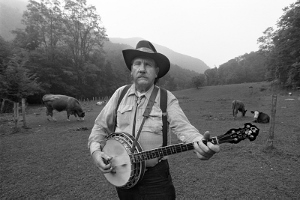
The Delmore Brothers – by John Lilly

“There was a big crowd there and everything was decorated and all fixed up like the president of the United States would be there. It was by far the biggest and most important contest in the entire country. People who had never been to a contest before gathered with the contestants at the Old Athens (Alabama) Agricultural School. My mother had made (guitar) cases for us out of cotton sacks we used during the picking season and we had our names on them spelled out in full. I painted them on the cases with pokeberry juice.

“You know how it
Read the rest

Cleo Davis, The Original Bluegrass Boy

Rural Roots of Bluegrass

By Wayne Erbsen

On March 9, 1919, a doctor rode his horse-drawn buggy through the hills of northwest Georgia to the home of Ben and Effie Davis. He was summoned because Effie was about to have a baby. By the time the Doc had left, Effie and John were the proud parents of a healthy baby boy. As yet, they had no name for him. By and by, they gave him the name Cleo.

As young Cleo was growing up, he was surrounded by music. Mama played the pump organ and sang the old hymns along with her brothers and

Read the rest

A History of Bluegrass Guitar in Western North Carolina

By John Martin

When folklorists like Cecil Sharp came to the mountains of North Carolina they found an enduring musical culture of Scotch-Irish fiddle tunes and ballad singers as well as some of the only black banjo and fiddle players in the country.  In the 1940s, western North Carolinians helped produce a new form of music: bluegrass. Earl Scruggs popularized the regional three-finger banjo style that in many ways defined bluegrass, and the state also made many contributions to guitar playing. 

While the acoustic guitar began as a rhythm instrument, North Carolinians Don Reno, Earl Scruggs, Doc Watson, and George

Read the rest

Grandpa Jones

By Charles Wolf

It was a hot night at the Grand Ole Opry in the summer of 1995. Out frontthe crowd in the Opry house was stocking up on Cokes and trying to explain to northern visitors what Goo ­Goos were. Backstage the talk was about whether or not the Houston Oilers were serious about moving to Nashville. An­nouncer Kyle Cantrell was checking over his schedule and getting ready to intro­duce the host for the 8:30 P.M. segment of the world’s longest running radio show. He smiled when he saw who was up next.­

Bradley-Kincaid,-Joe-Troyan-and-Grandpa-JonesAccompanied by his back-up band of

Read the rest

Samantha Bumgarner: The Original Banjo Pickin’ Girl

This article was written by Charles K Wolfe.

One of the sillier myths being bandied about these days by the Nashville establishment involves the role of women in the history of country music. It is said, down along Music Row and in the August pages of Country Music Magazine, that before the advent of Kitty Wells in the late 1940’s, women had little to do with country music’s devel­opment: they were cast as only pretty faces along to dress up the act. This, of course, is nonsense, and an account of the significant women artists who contributed to

Read the rest

Karl and Harty

Rural Roots of Bluegrass

By Wayne Erbsen

The search for the core of the roots of bluegrass always leads to the many brother acts that were so popular with rural audiences in the 1930s and 1940s. The familiar names that always crop up include the Monroe brothers, Callahan brothers, Delmore brothers and the Bolick brothers. Practically forgotten, but no less important to the roots of bluegrass, were Karl and Harty. Though “officially” not brothers, both were born in 1905, growing up in Mount Vernon, Kentucky, as if they were brothers. This same area produced such artists as Bradley Kincaid, Red Foley, and John Lair.

Read the rest

Fiddlin’ Arthur Smith

Rural Roots of Bluegrass

By Wayne Erbsen

Thunderstruck. What better word to use to describe the reaction of fans of old-time fiddle music when they first tuned into the Grand Ole Opry and heard the fiddling of Arthur Smith coming out of their radios? From the time Smith first stepped up to the WMS  microphone in December 1927, the world of southern fiddling would never be the same again. Who was this man that set fiddling so much on its ear?

Born April 10th, 1898, near Bold Springs, Tennessee, Arthur Smith got his first fiddle when his young wife, Nettie, sold enough chickens to

Read the rest

The Coon Creek Girls by John Lilly

Rural Roots of Bluegrass

On the evening of June 8,1939 limousines began to deliver the cream of Washington D.C. society to the East Room of the White House. President and First Lady, Franklin and Eleanor Roosevelt were entertaining King George VI and Queen Elizabeth of England and had arranged a command performance in their honor. Chandeliers sparkled, jewelry glistened, and the royal guests sat in the front row with their hosts. Music for the evening was provided by the finest representatives of American culture, including opera tenor Lawrence Tibbett, classical musician Marion Anderson, the large and popular Kate Smith, and Alan Lomax singing Western

Read the rest

Making His Own Way – Raymond Fairchild

By Wayne Erbsen

Published in Bluegrass Unlimited in March 1982

They call him “The Old Man of the Mountains.” At the spry age of 42, that makes Raymond Fairchild a rather youthful “old man.” No matter. The mountains can age you before your time, and Raymond has lived far enough back in the Smoky Mountains to be several generations old by now. This man, who many consider to be the fastest and the best banjo player alive, lays a genuine claim to playing mountain music. He’s lived it.

Born near Cherokee, North Carolina, to a Cherokee Indian mother and a

Read the rest

Wiley & Zeke Morris, The Morris Brothers

Rural Roots of Bluegrass

It all started with mama. It seemed like she could make music on about anything with strings on it and some things that didn’t, like the french harp. There never was enough time for mama to play, what with raising six rambunctious sons. But often on Saturday night she would put her work aside and get together with her two brothers, Rome and Joe, to make music. Joe played banjo in the old clawhammer style, and Rome played the fiddle. In addition to the hoedown square dance tunes, Rome was known to have played some beautiful waltz music on the

Read the rest